What Can't Go in a Dumpster in Georgia?
A rejected load costs time and money. Here is the full prohibited list, the reasoning behind it, and where each item actually needs to go.
In this guide
- Why the list exists
- Liquids, paint and solvents
- Fuel, oil and automotive waste
- Batteries, electronics and appliances
- Tyres
- Asbestos and the older-home problem
- Medical, chemical and agricultural waste
- What is perfectly fine
- Where to take the things that cannot go in
Every load that leaves a property goes across a scale and gets looked at. A container with prohibited material in it can be refused, and a refused load means the container comes back to you, still full, with the problem unchanged and a wasted trip on the invoice. Ten minutes of sorting beforehand avoids all of it.
Why the list exists
The prohibitions are not arbitrary and they are not the rental company being awkward. They come from three places: state environmental regulation, the operating permit conditions of the disposal facility, and straightforward safety.
A landfill operates under a permit that specifies what it may accept. Material outside that permit puts the facility's licence at risk, which is why gate staff check and why they refuse loads. The Newton County Landfill explicitly does not accept hazardous waste, and it also enforces a county ordinance restricting disposal to Newton County waste — commercial haulers have to document the origin of the load.
Safety is the other half. Compaction equipment crushing a sealed propane cylinder or a lithium battery is a genuine hazard to the people working there.
Liquids, paint and solvents
No liquids of any kind. Wet paint, stains, varnish, thinners, solvents, adhesives, pool chemicals and cleaning products all stay out.
Liquids create leachate, which is the contaminated runoff a landfill's entire engineering exists to control. They also make a load's weight unpredictable and can react with other materials in the container.
Latex paint is the common exception with a workaround. Dried out completely, it is generally acceptable as solid waste. Leave the lid off in a ventilated space, or stir in cat litter or a commercial paint hardener until it is solid throughout. It has to be genuinely dry, not just skinned over on top.
Oil-based paint, stains and solvents cannot be dried out and disposed of this way. They are household hazardous waste. Newton County runs a household electronics and paint collection on the first Saturday of each month, residential only, and that is the route for these.
Fuel, oil and automotive waste
Petrol, diesel, kerosene, motor oil, transmission fluid, brake fluid, antifreeze and fuel containers with residue in them all stay out. So do fuel tanks, whether or not you believe they are empty.
Propane cylinders are a specific and serious exclusion, including the small camping canisters. A sealed pressure vessel going through compaction equipment is exactly the hazard it sounds like. Barbecue cylinders can generally be exchanged or returned to a supplier.
This category is the one that turns up constantly in rural cleanouts around Mansfield, Newborn, Jersey and Monticello. A barn or workshop that has been in use for forty years will have accumulated fuel cans, oil drums and half-used chemicals in quantities the family clearing it has no idea about. Walk that building early rather than on the last day.
Batteries, electronics and appliances
Car and marine batteries are excluded — they contain lead and sulphuric acid and are readily recyclable, so most auto parts retailers take them back.
Lithium-ion batteries are the growing problem. Power tool packs, laptop and phone batteries, e-bike and scooter batteries all carry a fire risk when crushed, and battery fires at waste facilities have become a serious industry issue. Keep them out.
Electronics should not go in general waste. Newton County runs its residential electronics and paint recycling event on the first Saturday of each month, and that is the straightforward answer for a household clearance.
Appliances containing refrigerant — fridges, freezers, air conditioning units, dehumidifiers, some water coolers — require the refrigerant to be professionally recovered before disposal. Once that has been done and documented, the shell can go in. Appliances without refrigerant, such as ovens, washers and dryers, are generally fine.
Tyres
Tyres are excluded from general containers everywhere in Georgia, and they are handled under their own regulatory arrangement. They trap air, they float to the surface in a landfill, and they are managed through a dedicated scrap tyre programme.
At the Newton County Landfill there is a per-tyre charge that varies with size, and the county's convenience and recycling centres do not accept tyres at all. Set them aside separately and expect a specific charge rather than assuming they can ride along.
Farm properties are where this bites. A single barn clearance in south Newton County can turn up two dozen tractor and implement tyres, and those are not a rounding error on the disposal cost.
Asbestos and the older-home problem
This is the one that matters most around Covington, and it is worth taking seriously rather than hoping.
Asbestos was used in construction materials into the 1980s. Given how much of the housing stock around the Covington square, in Oxford, in Porterdale and across Madison's historic district predates that, the probability of encountering it in a renovation here is not small.
Common locations: pipe and boiler insulation, vinyl floor tiles and the black mastic adhesive underneath them, some textured ceiling finishes, cement board siding, roofing felt and shingles on older roofs, and some plaster and joint compounds.
Asbestos cannot go in a roll-off container under any circumstances. It requires testing, licensed abatement and documented disposal at a facility permitted to receive it. Georgia regulates this and the penalties for improper disposal are substantial.
The practical advice is straightforward. If you are opening up a property built before about 1985 and you encounter material you are not certain about, stop and have it tested before you disturb it further. Testing is inexpensive relative to what happens if you guess wrong, and disturbing asbestos-containing material is what creates the hazard.
Medical, chemical and agricultural waste
Sharps, medications, biohazard material and laboratory chemicals are all excluded and have their own disposal routes. Pharmacies frequently run medication take-back programmes.
Agricultural chemicals — pesticides, herbicides, fertilisers in quantity — are hazardous waste and cannot go in a container. Empty containers that have held them frequently cannot either, depending on the product. This comes up on nearly every farm property clearance in the southern half of the county.
Contaminated soil is its own category. Soil of unknown provenance, particularly around old fuel storage, needs testing before it can be disposed of, and that is a slower process than anybody wants it to be.
What is perfectly fine
The list of exclusions reads long, but the overwhelming majority of what a renovation or clearance produces is entirely acceptable:
- Timber, framing, plywood, decking and pallets
- Drywall, plaster, lath and insulation that is not asbestos-containing
- Roofing shingles, felt, flashing and old decking
- Flooring of all kinds, carpet and underlay
- Cabinets, countertops, doors, windows and fixtures
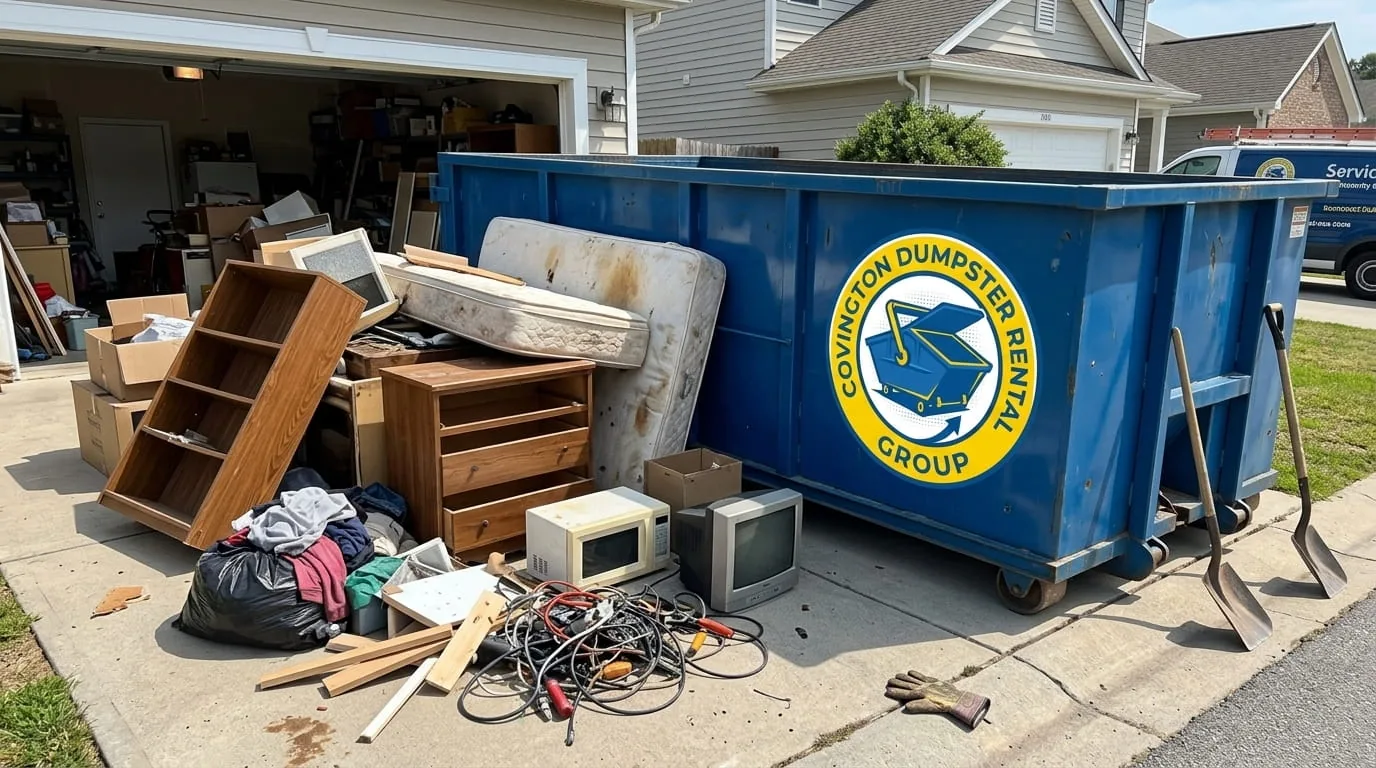
- Furniture, mattresses and general household contents, though mattresses often carry a per-item fee
- Yard debris, brush, branches and general landscaping waste
- Concrete, brick, block and stone, in a dedicated clean-fill container
- Metal, wiring and plumbing
- Appliances without refrigerant
Where to take the things that cannot go in
Household hazardous waste, paint and electronics: Newton County's residential collection runs on the first Saturday of each month. The county recycling and convenience centres operate on an annual vehicle hang tag, purchasable at the Cousins Center on Geiger Street, and are for residential use only.
Tyres: the Newton County Landfill on Lower River Road, at a per-tyre charge depending on size.
Car batteries: most auto parts retailers accept them for recycling.
Refrigerant appliances: an HVAC or appliance contractor for recovery, then the shell can be disposed of normally.
Asbestos: a licensed abatement contractor. Do not attempt this yourself.
If you are not sure about something, ring and ask before you load it. That call takes a minute. A rejected load takes a day.
Book a container in Covington
One flat rate covering delivery, seven days, pickup and disposal.
(470) 327-9027Questions readers ask about this
Can I put paint in a dumpster in Georgia?
Not in liquid form. Latex paint dried completely solid is generally acceptable — leave the lid off or use a hardener until it is dry all the way through. Oil-based paint, stains and solvents cannot be dried out and go to the county's monthly household paint and electronics collection instead.
Can I put a mattress in the container?
Usually yes, though mattresses commonly carry a per-item processing fee. Tell us how many when you book and we will quote it up front rather than adding it afterwards.
What do I do about asbestos in an old Covington house?
Stop and have it tested before disturbing it further. It cannot go in a roll-off under any circumstances and requires licensed abatement with documented disposal. Given how much of the local housing stock predates the 1980s, this is worth checking rather than assuming.
Why can't tyres go in with everything else?
They are managed under a separate scrap tyre arrangement across Georgia. The Newton County Landfill charges per tyre depending on size, and the county convenience centres do not take them at all.